01 ——

The technological
moment

For most of human history, the tools available to science have imposed a hard ceiling on the questions science could answer. Phenomena that manifested across populations, across time, and across domains simultaneously were effectively unstudable — not because they lacked reality, but because no analytical framework existed to characterize them at scale.

That ceiling has lifted. The exponential advance of artificial intelligence, machine learning, and large-scale pattern recognition has fundamentally changed what is possible. Global sensor networks now generate continuous streams of geophysical, atmospheric, electromagnetic, and biological data. Cloud infrastructure can store and process that data at a scale that would have been unimaginable a decade ago. And modern AI systems can find signal in datasets of a complexity and dimensionality that no human analyst could navigate alone.

We are living through the first moment in history when the tools exist to study the hardest questions rigorously. The only question is whether science has the methodological discipline to use them well.

AI · ML ——
Pattern Recognition at Scale

Modern machine learning can identify signal convergence across independent data streams that no single-domain analysis would detect. Cross-modal pattern recognition is now a solved infrastructure problem.

SENSORS ——
Global Data Collection

Continuous streams from GPS networks, magnetometers, ionospheric sensors, atmospheric instruments, and human coherence monitors now provide real-time planetary coverage at unprecedented resolution.

CLOUD ——
Infrastructure Without Limits

Cloud computing eliminates the storage and processing constraints that made large-scale multi-domain analysis prohibitive. The analytical ceiling is no longer hardware — it is methodology.

02 ——

The open
question

The historical and experimental record of anomalous human cognition is extensive. Documented across cultures and centuries, replicated under controlled laboratory conditions in peer-reviewed research programs spanning decades, and consistent enough in its characteristics that dismissal now requires more explanation than investigation.

The SRI remote viewing program, the PEAR laboratory at Princeton, the Ganzfeld meta-analyses, the Global Consciousness Project — these are not fringe endeavors. They are rigorous scientific programs that produced results current theoretical frameworks cannot adequately explain. The scientific community's failure to integrate these findings was not a judgment on the evidence. It was a consequence of analytical infrastructure that did not yet exist.

What has been missing is the capacity to characterize it rigorously at scale, to subject it to the same pre-registration standards and statistical discipline that govern any credible scientific inquiry, and to test whether it carries actionable signal in real-world domains.

The question is no longer whether these phenomena warrant study. It is whether we have the methodological commitment to study them well.

SRI Remote Viewing · 1972–1995
p < 10⁻¹⁹
Probability if chance alone (Utts, 1995)

Utts (1995) peer-reviewed assessment of 26,000+ SRI/SAIC trials concluded: "Using the standards applied to any other area of science, psychic functioning has been well established." Results far beyond chance; methodology soundly vindicated.

Utts, J. (1995) · Journal of Scientific Exploration
SRI / SAIC Stargate Program · 1972–1995
Ganzfeld · Bem & Honorton (1994)
32%
Hit rate vs. 25% chance

Meta-analysis across 28 autoganzfeld studies: consistent hit rate above the 25% mean chance expectation, z = 6.6, p = 2.8 × 10⁻¹⁰. Robust across methodological variations.

Chance
25%
Observed
32%
Bem & Honorton (1994) · Psychological Bulletin · z = 6.6
Global Consciousness Project · 1998–Present
7σ+
Cumulative network deviation

25+ years of continuous operation. ~70 globally distributed REG devices show persistent correlated deviation coincident with major world events, sustained across hundreds of pre-specified hypothesis tests.

Nelson, R. et al. · Princeton Engineering Anomalies Research · ~70 REG devices · 500+ pre-specified events · 1998–present

The evidence has been there for centuries. We are building the infrastructure to evaluate it rigorously with translational intent.

SRI · 1972–1995

Stanford Research Institute remote viewing program, government-funded, produced statistically significant results across thousands of trials under controlled conditions.

PEAR · 1979–2007

Princeton Engineering Anomalies Research laboratory documented micro-PK and remote perception effects across decades of peer-reviewed experimentation.

Ganzfeld · Meta-Analysis

Hit rates consistently exceeding chance expectation across hundreds of independent replications. Effect sizes small but robust across methodological variations.

GCP · 1998–Present

Global Consciousness Project documents correlated deviations in distributed RNG networks coincident with large-scale human events. Cumulative Z-score sustained over decades.

03 ——

The methodological
commitment

The Synexis Project does not need to resolve the hard problem of consciousness to do useful work. Whether anomalous cognition arises from quantum coherence, non-local field effects, information structures we do not yet have language for, or something else entirely — the methodological question is the same: does it produce detectable, reproducible, statistically characterizable signal? And if so, can that signal be translated into practical benefit?

That is a question science can answer. Not by lowering its standards, but by applying them with the same rigor brought to any other empirical domain. Pre-registered hypotheses. Open infrastructure. Null-result transparency. Convergence testing across independent data modalities. The same discipline that governs the most credible work in any field.

The goal is not to prove a belief. It is to find out what is actually there — and to be rigorous enough that the answer, whatever it is, can be trusted.

What we are not doing

Advocating for a conclusion before the data is examined. Selectively reporting results that confirm a hypothesis. Treating prior experimental precedent as resolved proof without replication under our own pre-registered methodology. Lowering methodological standards because the questions are unconventional. The work either survives scrutiny or it doesn't. We need to know which.

What we are doing

Locking hypotheses and analytic protocols before any data is examined. Publishing null results with the same rigor as positive findings. Building infrastructure that can be audited by any independent reviewer. Testing the convergence of human intuition and environmental data against real-world outcomes at scale.

04 ——

The translational
goal

The ambition of The Synexis Project is not purely academic. The questions we are investigating have direct real-world implications — for geophysical hazard awareness, for understanding the nature of human perception, and for the possibility that anomalous cognition, properly characterized and integrated, could become a meaningful input to systems designed to protect and benefit humanity.

We may be at the beginning of understanding how to combine the two greatest analytical capabilities available to us: the pattern-recognition power of artificial intelligence operating across vast datasets, and the signal-detection capacity of human intuition operating across dimensions that instruments have not yet fully learned to measure.

That combination, subjected to genuine scientific rigor, is what The Synexis Project is built to explore. Not because the answer is assumed — but because the question is too important not to ask, and the tools to ask it properly finally exist.

The question is too important not to ask — and the tools to ask it properly finally exist.

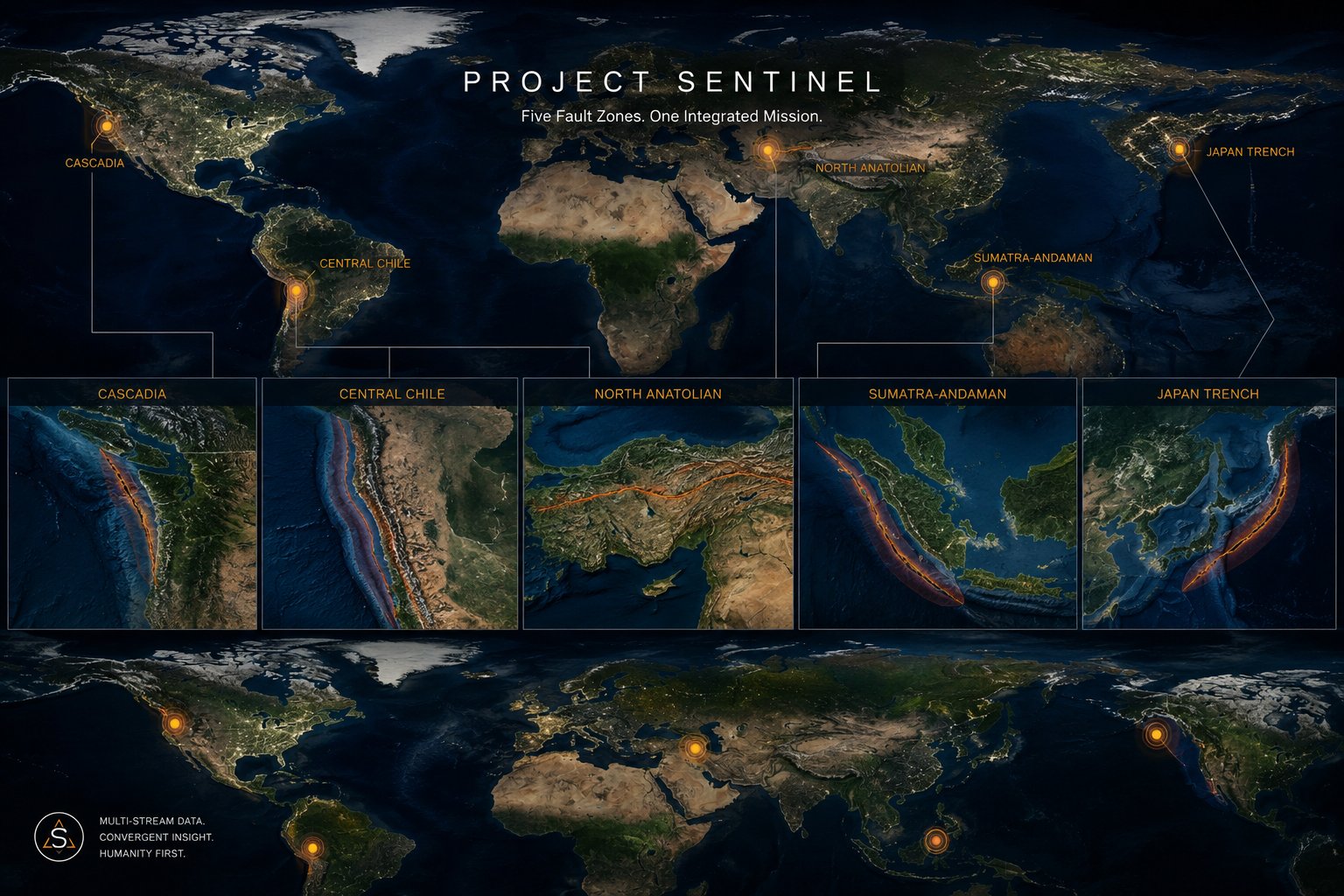
Project Sentinel Five Fault Zones

Project Sentinel · Five Fault Zones · One Integrated Mission

GPS Deformation AUROC H2 · 2,746 stations
N. Anatolian: 0.714 — sole region exceeding pre-specified threshold of 0.65.

Four initiatives,
one framework